
AFW + NFSA #78: Three Shorts by Joyce Wieland
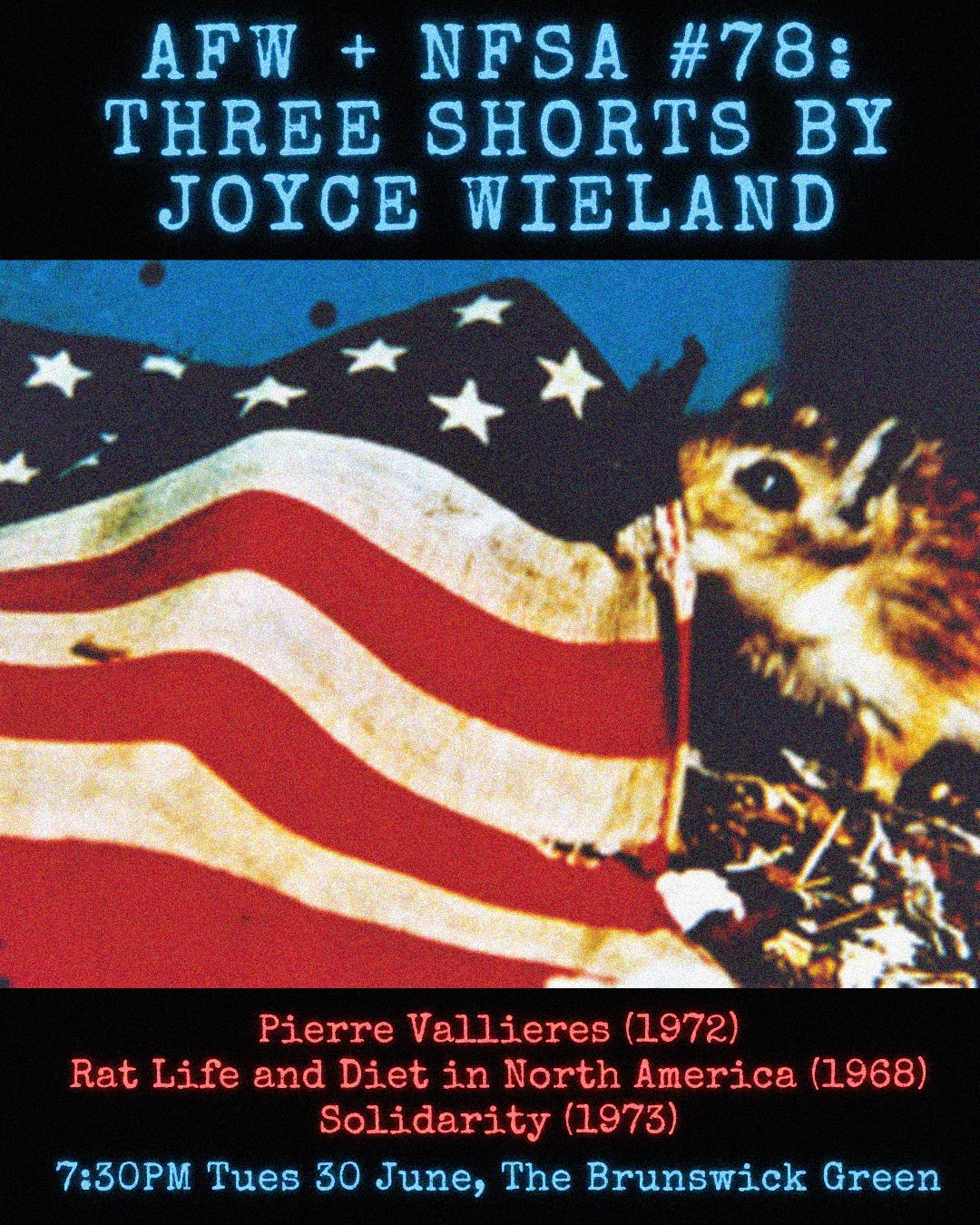
7:30PM Tuesday 30 June
The Brunswick Green, 313/315 Sydney Rd, Brunswick
$10 on the door. 16mm projection
Joyce Wieland (June 30, 1930 – June 27, 1998) hailing from Toronto, Canada, was an influential filmmaker and artist working across diverse media, from textiles and painting to experimental film. She is renowned for her often humorous works that engage with many social and political issues, from war and nationalism to ecology, sexuality and feminism. Initially working as a painter and for an animation studio in Toronto, Wieland moved to New York in the 1960’s with her partner Michael Snow, and the pair became a part of the city’s avant-garde filmmaking scene. She was the only woman filmmaker identified by P. Adams Sitney in his seminal essay on the Structuralist film movement. Wieland’s films demonstrated her sharp wit and narrative sensibility, foreshadowing filmmaking styles of the 80’s and 90’s.
AFW presents 3 shorts by Joyce Wilend, linked by their humour and political commentary.
FILMS:
Rat Life and Diet in North America, 16mm, 1968, 16 mins
A group of gerbils are political prisoners in the United States, being held prisoner by a cat. They make an escape to Canada. This allegorical film reflects the political climate of the late 1960’s with many students and leftists protesting and fleeing to Canada to avoid being drafted into the Vietnam War.
“I can tell you that Wieland's film holds. It may be about the best (or richest) political movie around. It's all about rebels (enacted by real rats) and police (enacted by real cats). After long suffering under the cats, the rats break out of prison and escape to Canada. There they take up organic gardening, with no DDT in the grass. It is a parable, a satire, an adventure movie, or you can call it pop art or any art you want - I find it one of the most original films made recently.” - Jonas Mekas
“The film is witty, articulate, and a far cry from all the other cute animal humanism the cinema has sickened us with in the past. Nevertheless it is a vital extension of the aspect of her films that runs counter to the structural principle: ironic symbolism.” - P. Adams Sitney
Pierre Vallieres, 16mm, 1972, 30 mins
This film documents a speech given by Pierre Vallieres, a French Canadian intellectual, who was a Central part of the FLQ (Front de libération du Québec). Wieland’s camera is closely cropped on the mouth of Vallieres, highlighting the physicality of the mouth and importance of the voice.
“He delivered three essays, without stopping, except for reel change and camera breakdown: 1) Mont Laurier; 2) Quebec history and race; 3) women's liberation. Everything which happened is recorded on film. It was a one-shot affair, I either got him on film or I missed. What we see on film is the mouth of a revolutionary, extremely close, his lips, his teeth, his spittle, his tongue which rolls so beautifully through his French, and finally the reflections in his teeth of the window behind me.” - Joyce Wieland
Solidarity, 16mm, 1973, 10 mins
Filmed at a strike in the early 1970’s this film follows the feet and legs of the protestors, as they walk, and march across grass and asphalt, with the word ‘Solidarity’ super imposed across the screen.
These films will be preceded by ‘Heads or Tails?’, a 16mm short film by AFW member Rowena Crowe.
“Australian coins provide a set of instructions that question how to live in a capitalist colonial society in the time of climate uncertainty. Head or Tails was shot on a hand wound Bolex following self-imposed instructions over a single roll of film. Setting the focus to close range, I let the flip of a coin decide which direction the camera “walked”. The camera, fixed to a mono-pod, strides through the landscape till the film wind or path runs out.” - Rowena Crowe.
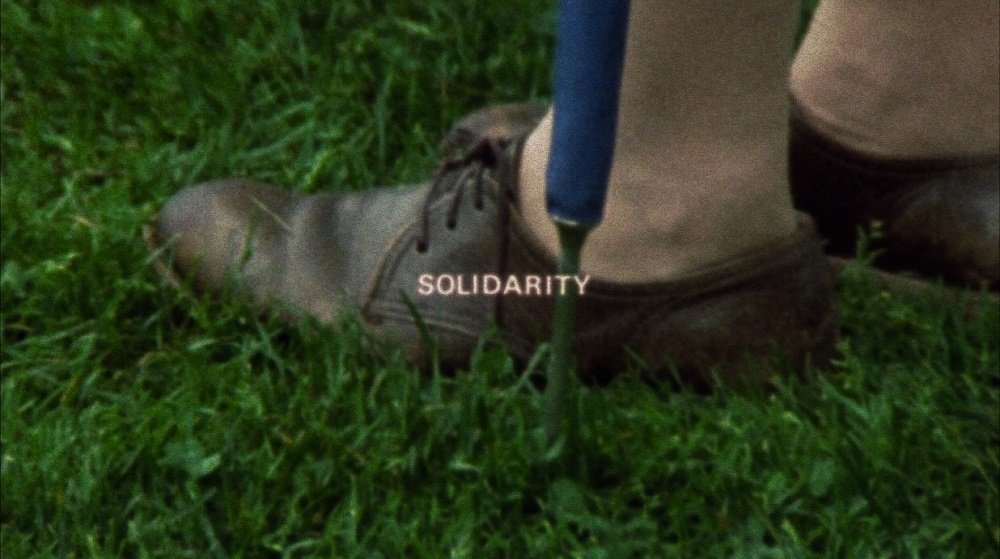
Image: ‘Solidarity’ (1973)